
Common dormer roof problems and how to fix them
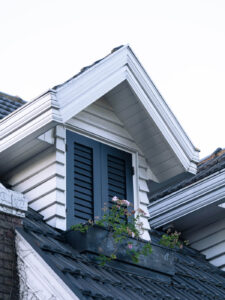
Dormers are brilliant for adding headroom and light to a loft room, and they’re everywhere in Surrey, from small traditional dormers on cottages to the big box dormers added during loft conversions. But a dormer adds lots of extra joints, edges and junctions to a roof, and every one of those is a place where water can get in.
If you’ve got a damp patch in a loft bedroom, the dormer is one of the first places we’d look.
What are the parts of a dormer?
It helps to know the names, because each part goes wrong in its own way:
- The dormer roof: often a small flat roof, though some dormers have a pitched, tiled roof of their own.
- The cheeks: the triangular or square side walls, usually clad with tiles, slate, timber or uPVC.
- The face: the front of the dormer, where the window sits.
- The flashings: the lead or other weatherproofing that seals the dormer to the main roof.
What are the most common dormer roof problems?
A worn-out flat roof
Many dormers were finished with traditional felt, and small felt roofs take a hammering from the sun. Cracks, blisters and lifted edges are very common after 10 to 15 years. Because the roof is small, water gets into the room below quickly when it fails.
Failed leadwork
Where the dormer meets the main roof, there should be lead flashings (an apron along the bottom and soakers up the sides) to stop water running behind the joint. If the lead has split, been cut too short or was never fitted properly, water tracks down inside the dormer cheek or into the room. It’s very similar to what happens around chimneys, which we cover in common causes of chimney leaks.
Damaged cheeks
Tile-hung cheeks can lose tiles in high winds, and timber cladding can rot if it isn’t maintained. Either way, water gets behind and into the timber frame of the dormer.
Tired fascias, soffits and gutters
The small gutter on a dormer is easy to forget because it’s high up and hard to see. If it blocks or the boards rot, water overflows down the front of the dormer and the window. Swapping old timber for uPVC fascias and soffits and new guttering saves a lot of maintenance.
Condensation
Loft rooms with a dormer are often warm and well used, but some older conversions weren’t built with enough insulation or ventilation. That can lead to condensation and mould in the corners, which is sometimes mistaken for a leak. See our roof ventilation FAQs for more on this.
How do you repair a leaking dormer?
Re-covering the dormer roof
If the flat roof is worn out, re-covering it is usually the answer. For dormers we often recommend GRP fibreglass or EPDM rubber. Both are long-lasting, seamless across the main area and well suited to small roofs with lots of edges. While the roof is open, we check the deck for rot and replace any soft boards.
Renewing the leadwork
Split or badly fitted lead flashing can be cut out and replaced with new lead dressed properly into the main roof. Done right, it should last for decades.
Repairing or re-cladding the cheeks
Missing tiles can be replaced, and rotten cladding can be renewed. On larger dormers, re-cladding the cheeks in a low-maintenance material can freshen up the look of the house too.
Do you need permission to repair a dormer?
Repairs and like-for-like re-covering don’t usually need planning permission or Building Regulations approval. Building a new dormer, or making one much bigger, is a different matter. That will need Building Regulations approval and sometimes planning permission too. We explain more in our post on planning permission and building regs for new roofs.
Dormer repairs in Reigate, Redhill and across Surrey
If your dormer is leaking or just looking tired, we can find the cause and fix it properly. We repair and re-cover dormers across Reigate, Redhill, Kingswood, Lingfield and the surrounding areas. You can see some of our recent work in our gallery, or get in touch with Collier Roofing for a free quote.