
Why roof valleys leak (and how we fix them)
Wherever two slopes of a roof meet in an inward corner, you’ve got a valley. You’ll find them on L-shaped houses, around extensions and where a dormer or bay joins the main roof.
A valley is basically a channel. It collects the rain running off both slopes and carries it down to the gutter, so in a heavy downpour it’s handling more water than any other part of the roof. When something goes wrong there, it tends to go wrong quickly. And because water can travel along the timbers before it drips, the damp patch inside often shows up a metre or two away from where the actual problem is.
What are roof valleys made of?
Lead valleys
On older homes in Surrey, the most common type is a lead valley: lead sheet dressed into the channel, with the tiles cut and bedded along each side. Done properly, lead lasts for decades.
GRP fibreglass valleys
Newer roofs and re-roofs often use GRP fibreglass valley troughs. These are moulded one-piece channels that are quick to fit and don’t attract metal thieves. It’s the same tough material we use for GRP fibreglass flat roofs.
Valley tiles and other types
Some roofs, particularly those with clay plain tiles, have valley tiles: purpose-made curved tiles that sit in the corner and lock in with the tiles on each slope. You’ll also come across mortar-pointed and felt-lined valleys on cheaper or older jobs, and those are usually the first to give trouble.
Why do roof valleys leak?
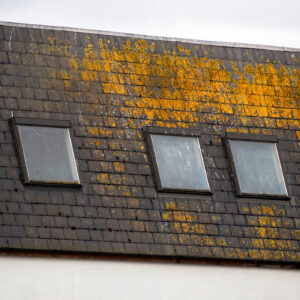
The most common cause we see is simply debris. Leaves, moss, twigs, the odd tennis ball – anything that sits in the valley slows the water down. In a heavy shower it backs up and spills sideways under the tiles. If you’ve got trees near the house, autumn is when this catches people out. Moss is a problem in its own right too, as we explain in why moss, lichen and algae damage roofs.
After that, it’s usually one of these:
- Split or cracked lead. Lead expands and contracts with the temperature. If the sections are too long, the lead is too thin, or it’s been nailed in the wrong places, it eventually fatigues and splits.
- Failed mortar along the edges of the cut tiles, letting water and wind get in.
- Slipped cut tiles. The tiles along a valley are cut at an angle, and the small pieces can lose their fixing and slide down into the channel.
- A valley that’s too narrow, so heavy rain overshoots the channel and gets under the tiles either side.
- Poor laps where one section of lead or GRP overlaps the next.
How can you tell if the valley is the problem?
Common clues are a damp patch on a ceiling near an internal corner of the house, or water stains running along the rafters in the loft directly under the valley line. Leaks that only appear in very heavy or wind-driven rain often point to a valley too. From outside, a thick line of moss or debris along the valley is a pretty good sign that water isn’t getting away as it should.
Valleys aren’t the only place leaks like to hide. Chimneys are another common culprit, and our guide to the common causes of chimney leaks is worth a read if your damp patch is near the stack. If water is coming in right now, see our page on dealing with a roof leak at home.
How do you repair a leaking roof valley?
Smaller repairs
It depends what we find. Sometimes it’s as simple as clearing out debris and re-fixing a few cut tiles. A small split in otherwise healthy lead can sometimes be repaired, or that one section can be replaced.
Replacing the valley
If the lead is worn out or the valley was badly built in the first place, the proper fix is to strip the tiles back on both sides and start again. That means checking the valley boards underneath, which are often soft after years of slow leaks (see the signs your roof timbers have wet or dry rot). Then we lay a new lead or GRP valley, and cut and fix the tiles back properly. It’s a bigger job, but it’s done once and done right.
How can you stop valleys leaking in the first place?
Keep them clear. If you have overhanging trees, it’s worth having the valleys and gutters checked once a year, ideally in late autumn after the leaves have come down. Catching a slipped tile or a blocked valley early costs very little compared with repairing ceilings and timbers after a winter of slow leaks.
Roof valley repairs in Kingswood, Lingfield and across Surrey
If you’ve got a damp patch you can’t trace, or you can see your valley is full of moss and leaves, give us a call. We repair and replace lead and GRP valleys across Kingswood, Lingfield, Redhill, Reigate and the surrounding areas. Contact Collier Roofing for a free roof check and an honest quote.