
Roof leak or loft condensation? How to tell the difference
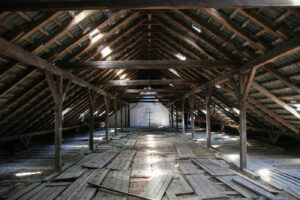
Every winter we get calls that start the same way: “I’ve been up in the loft and there’s water dripping off the roof.” Sometimes it’s a leak. Quite often it isn’t. It’s condensation, and patching the roof won’t make a blind bit of difference.
The good news is that the two usually leave quite different clues, and you can often work out which one you’re dealing with before you call anyone.
Why does condensation form in a loft?
A normal household puts a surprising amount of moisture into the air every day, from showers, cooking, drying washing indoors and even breathing. Warm, damp air rises, and it finds its way into the loft through the hatch, around downlights and through gaps where pipes and cables go through the ceiling.
When that air hits the cold underside of the roof, it turns back into water. You get droplets on the felt, beads of water on the nail tips, and on a really cold night a layer of frost that drips as it thaws in the morning.
There’s a slight irony here. A well-insulated loft keeps your house warm, but that also means the loft itself is colder than it used to be, so good ventilation matters more than ever.
How can you tell a roof leak from condensation?
Check when the water appears
The biggest clue is timing. A leak shows up during or just after rain, especially heavy or wind-driven rain. Condensation tends to be worst on cold, clear mornings, even when it hasn’t rained for days.
Check where the water is
A leak normally starts from one point, such as near a chimney, a valley, a vent pipe or a slipped tile, and often tracks down a rafter, leaving a stain. Condensation is spread out: droplets across large areas of the felt, damp on the gable walls, rusty nail tips, or black mould spotting the timbers in lots of places.
Try the dry-morning test
If you’re not sure, go up into the loft with a torch on a dry, cold morning. If it’s wet up there and it hasn’t rained, condensation is the likely culprit.
What usually causes loft condensation?
In our experience, the same few things come up again and again:
- Blocked eaves. Loft insulation pushed right into the eaves stops air coming in at the bottom of the roof. We see this a lot after a loft insulation top-up.
- Extractor fans venting into the loft. A bathroom fan that blows into the roof space instead of outside is pumping damp air exactly where you don’t want it.
- Old, non-breathable felt with no vents at the eaves or ridge, so moist air has nowhere to go.
- An unsealed loft hatch letting warm air from the landing straight up.
- Drying clothes indoors without opening windows or using an extractor.
How do you fix condensation in the loft?
The aim is to stop as much damp air getting up there as possible, and to let what does get up there escape.
Inside the house
That might mean ducting the bathroom fan out through the roof or the soffit, and fitting a draught seal around the loft hatch.
On the roof
The usual fixes are eaves vents or soffit vents, insulation spacers (rafter trays) so air can flow over the insulation, tile vents, or a ventilated dry ridge. Which combination is right depends on how your roof was built, and that’s something we can advise on once we’ve seen it. Our roof ventilation FAQs go into the options in more detail.
It’s worth sorting out. Years of condensation can lead to mould, damp insulation that doesn’t do its job, and eventually rot in the roof timbers.
What if it really is a leak?
Then it needs finding and fixing before the winter weather makes it worse. Common culprits are slipped or loose tiles, chimney flashing, valleys and failed ridge mortar. Don’t go walking on the roof to look for it. Take photos of what you can see in the loft, have a look at our advice on what to do about a roof leak at home, and give us a call.
Roof checks in Reigate, Redhill and across Surrey
Whether it turns out to be a leak or condensation, we can tell you which one it is and what it will take to put it right. We cover Reigate, Redhill, Kingswood, Lingfield and the surrounding areas of Surrey. Contact the Collier Roofing team for a free roof check.